 Realyld
The tokenisation gap nobody talks about
I’ve spent the last ten years building financial infrastructure for institutional markets.
Not the glamorous kind. The plumbing. Analytics platforms, transaction systems, custom equity index infrastructure. The kind of work where a single corporate action on a custom index — a ticker change, a stock split, a rebalancing — puts dozens of people across multiple institutions on a conference call for hours, manually reconciling books across counterparties in real time.
I’ve seen what that looks like from the inside. It’s an expensive, fragile, deeply human process held together by spreadsheets, Bloomberg terminals, and institutional memory.
And I’ve watched my firm spend months and millions of dollars building dedicated fiber connections to data centers — just to shave microseconds off transaction latency. In institutional markets, shaving those microseconds translates directly into alpha. Nobody builds that kind of infrastructure because it sounds cool.
So when people ask me what I think about tokenisation of real-world assets, I give them a different answer than they expect.
I’m not a believer. I’m not a skeptic. I’m someone who has seen the inefficiencies from the inside — and sees exactly where this technology could fix them.
The numbers are real. The hype is not.
The numbers from rwa.xyz tell an interesting story: $29.18 billion in distributed asset value, over 720,000 holders, growing 9% in the last 30 days alone.
That’s not the same as saying tokenization has arrived. There’s a long way between “interesting pilots” and “this is how capital markets actually work now.”
$29 billion sounds large until you remember that the global bond market alone is over $130 trillion. Private credit — one of the largest categories of tokenized RWAs by total value — represents a fraction of a percent of the total addressable market. We’re at the beginning of something real, not the middle of something transformative.
The optimists will tell you the trajectory matters more than the absolute size. They’re right about that. But trajectory without structural foundations is just a trend. And this space has had plenty of trends that went nowhere.
What actually changed in Q1 2026
Two things happened in March that matter more than most people realize.
On March 17, the SEC and CFTC jointly classified 16 crypto assets as digital commodities — ending over a decade of regulatory ambiguity that kept institutional capital sitting on the sidelines.
That same day, Amundi — Europe’s largest asset manager with approximately $2.3 trillion in assets under management — launched a $100 million tokenized fund called SAFO on Ethereum and Stellar.
The timing wasn’t a coincidence and the significance is what $100 million from Amundi signals: legal, compliance, and custody questions are solved enough to commit real capital.
I’ve seen enough product launches to know the difference between an institution running a proof of concept and an institution writing a check. Amundi wrote a check.
The problems nobody talks about honestly
Here’s where I part ways with both camps.
The crypto optimists treat every institutional announcement as validation that mass adoption is weeks away. It isn’t. The gap between “Amundi launched a tokenised fund” and “tokenised assets are standard financial infrastructure” is enormous — and closing it will take years of unglamorous work on custody standards, secondary market liquidity, and cross-border regulatory frameworks.
The TradFi skeptics, meanwhile, dismiss the whole space as speculative noise. That’s also wrong — and increasingly expensive to believe.
Let me give you a concrete example of what I mean.
I’ve watched corporate action processing on a custom equity index bring together teams from multiple institutions — operations, legal, risk, technology — just to handle a routine rebalancing. Dozens of people. Hours of calls. Manual reconciliation across counterparties. All because our systems were designed in an era when T+2 settlement and exchange opening hours were simply facts of life, not problems to be solved.
And markets are still built around these constraints. Exchanges open and close. Settlement takes days. A 24/7 global financial system is technically possible — but operationally, institutionally, we’re not built for it.
This is the tokenization gap nobody talks about. Tokenizing an asset is, at this point, a largely solved problem. You can put a Treasury bond on-chain in an afternoon.
The gap is everything that happens next. When that tokenized asset needs to interact with a clearing house running on SWIFT. When it needs to be reflected in a book of record built in 1994. When a corporate action cascades across counterparties running completely different systems on completely different timelines.
That’s the actual problem tokenisation is trying to solve. Not token prices. The messy, expensive, human-dependent infrastructure underneath — the part that nobody tweets about.
T+2 settlement creates counterparty risk that nobody fully prices in because it’s so normalized we’ve stopped seeing it. Fractional ownership of structured products is technically possible in traditional finance but operationally nightmarish — minimum ticket sizes exist because the administrative overhead makes smaller positions uneconomical, not because there’s anything fundamentally preventing them.
These aren’t minor inconveniences. They’re structural inefficiencies that tokenization genuinely addresses — 24/7 settlement, fractional access, programmable compliance. I’ve seen how these constraints shape product decisions in traditional platforms. Removing them changes what’s possible for who.
The large institutions building on blockchain infrastructure quietly — and there are more of them than you’d think — aren’t doing it because someone read a whitepaper. They’re doing it because they’ve run the numbers on operational costs and the math works.
The pragmatist’s framework
So where does that leave us?
When I look at any RWA development — a new protocol, a fund launch, a regulatory update — I ask three questions. They cut through most of the noise.
Question 1: Can it actually be tokenized?
For most mainstream asset classes — Treasuries, money market funds, private credit — the answer is now broadly yes. The legal structures exist. Institutional custodians exist. Compliance tooling works. The SEC/CFTC classification in March removed the last major regulatory ambiguity for US institutions. This question is largely settled, and it’s not where the interesting work is happening anymore.
Question 2: Will institutions actually use it?
This is where it gets more interesting. Tokenized Treasuries and money market funds — yes, and accelerating. BlackRock’s BUIDL, Franklin Templeton’s BENJI, Amundi’s SAFO. Real capital, real institutional mandates.
But move beyond those familiar asset classes — private equity, real estate, commodities, fine art — and the picture gets murkier. Secondary liquidity is thin. Legal enforceability of on-chain contracts remains contested in most jurisdictions. The operational overhead that made tokenization theoretically attractive hasn’t actually been reduced enough to change behavior at scale.
Question 3: Does it actually work — in practice, over time, under stress?
This is the question most RWA analysis skips entirely. And it’s the one that matters most from a product perspective.
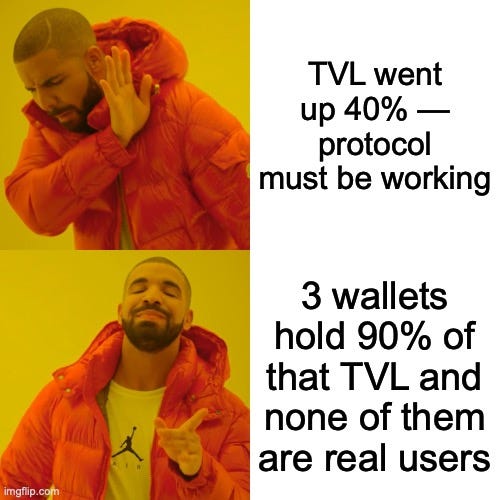
TVL tells you how much capital is parked somewhere. It doesn’t tell you whether people are coming back, whether activity is concentrated in a handful of wallets, whether the protocol retains users or just capital, or whether the product actually behaves the way its whitepaper describes when conditions change.
This is the PM lens applied to on-chain finance. Not “can it be built” — but “does it work for the people it’s supposed to serve, consistently, over time.” It’s the same question I’ve spent ten years asking about financial platforms in traditional markets. The answers are usually more complicated — and more interesting — than the headline numbers suggest.
This is what Realyld will focus on.
Why I’m writing this
There are two kinds of voices in the RWA conversation. Crypto natives explaining blockchain to other crypto natives. And traditional finance professionals who follow this space closely tend to do so quietly — for reasons anyone in the industry would understand.
I’ve spent ten years in the second camp — watching these inefficiencies up close, understanding exactly where they come from, and now watching a new generation of infrastructure being built that could finally fix them.
I’m building Realyld because I think there’s a third voice missing. Someone who understands both the institutional plumbing and the on-chain mechanics — and is willing to say what’s actually happening without cheerleading or dismissing.
That’s what this newsletter will be. Analysis of DeFi and RWA protocols through a capital markets lens.
Behavioral data, not price targets.
Product thinking, not token speculation.
If you’ve ever sat through a pitch about tokenization and thought “but does this actually work?” — you’re in the right place.
🎭 Meme of the Issue — because sometimes a picture explains the gap better than 1,200 words
Data sources
Market data: rwa.xyz (as of April 10, 2026)
Amundi SAFO launch: The Block, March 17, 2026
SEC/CFTC classification: Joint interpretive release, March 17, 2026
Realyld publishes analysis on DeFi and RWA protocols for builders and allocators. Subscribe to get each issue directly.
Originally published on the Realyld newsletter.